
How to Plan Next Year's Church Budget Using This Year's Giving Data
Published Nov 15, 2026. 5 minute read
Share

Chisom Okafor
When do you plan your church's budget for the year? At the start of the new year? Whenever the team can finally come together? The best thing you can do for your church budget planning is to plan early, ideally between October and December of the previous year.
But planning early is only half of it. It is also about planning with what the current year's giving data says. Since you will be planning from October to December, you will have almost a full year of giving records to work with. In this blog, we will take you through the steps to use that data.
What Are the Steps to Plan Next Year's Church Budget Using This Year's Giving Data?
Planning a budget feels like a big task, but it becomes simple one step at a time. Here are the five steps to plan your church budget for next year, from gathering the numbers to presenting it to your members.
Step 1: Start Church Budget Planning Early, in October or November
Realistically, most churches wait until December. By then, everyone is busy with end-of-year programs and preparing the church for the holiday visitor surge, so the budget gets rushed. When your administration starts in October, or even November, there is enough time to gather the numbers and speak with ministry leaders.
The leaders, in turn, come forward with the anticipated needs of their departments. A church finance guide from the USC Center for Religion and Civic Culture even recommends starting four to six months before the church conference that approves the budget.
Step 2: Pull Your Giving Data
If you are wondering how to create a church budget from scratch, start with four things from your records:
- Giving for each month of the year
- Recurring givers compared with one-time givers
- Attendance for each month
- Spending for each ministry
Put them side by side and look for patterns. If you have two or three years of records, compare your church giving trends across all of them.
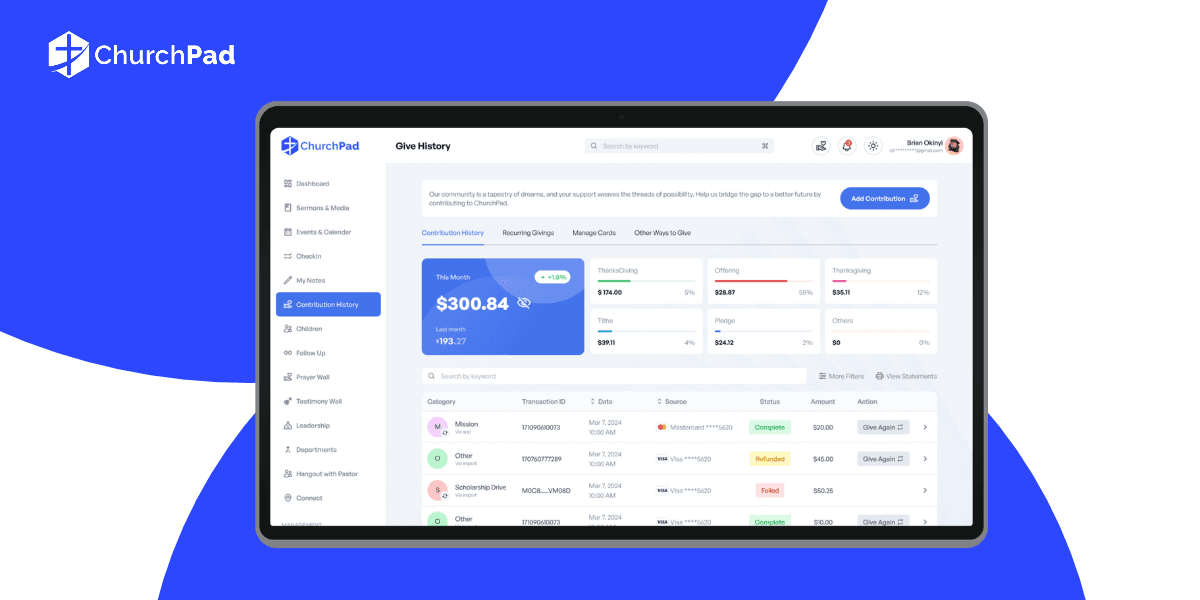
A quick side note: getting these records accurately and easily is much simpler with church operating software. ChurchPad, for example, tracks giving for each member and shows what each person gave to. You can set up recurring giving, and you can generate a weekly or monthly overview of your church finances without piecing anything together by hand.
Step 3: Do Your Church Income Forecasting
Church income forecasting is easier when you treat steady giving and uneven giving differently. The safe rule is to plan on the low side.
For example, say your church received $120,000 this year, made up of $70,000 from recurring givers and $50,000 from one-time gifts. Recurring gifts come on a schedule, so you can count them in full after removing anyone who has stopped giving. One-time gifts are harder to predict, so count only 70 percent of them, which is $35,000. Your church budget for next year is then built on $105,000.
The 70 percent is only an example, so use a figure your own records support. If giving comes in lower, you will not have to cut programs halfway.
Step 4: Set Ministry Budgets Using Church Budget Categories
Many churches copy last year's spending and add a small percentage. It is quick, but it carries old habits into the new year.
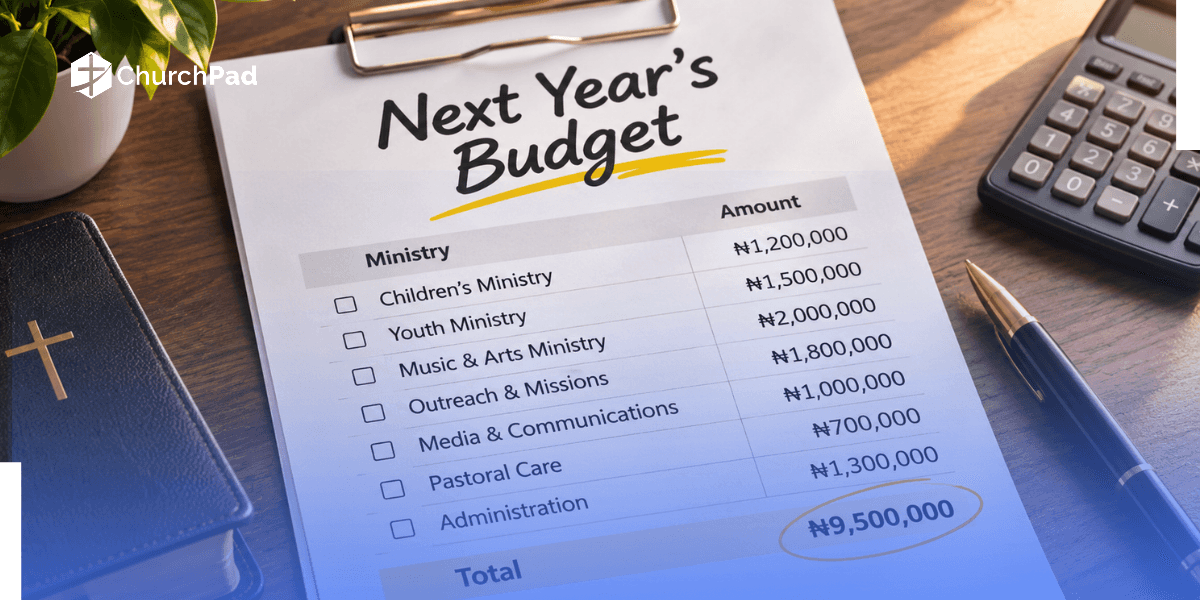
A better way is to ask each ministry leader what they plan to do and what it will cost. Then place every request under the main church budget categories, which are staff, facilities, missions, and ministry. A simple church budget template is enough for this, with the four categories down the left side and last year, this year, and next year across the top.
When the total goes above your forecast, which is common, the church finance committee decides together what to fund first and what can wait.
Step 5: Hold the Church Budget Meeting and Present to the Congregation
A clear church budget meeting agenda keeps the discussion on track. Try this order:
- Review this year's giving and spending.
- Share the income forecast.
- Go through each ministry request.
- Decide what to fund now and what can wait.
- Agree on how to present the budget to the congregation.
As for how to present a church budget to the congregation, use plain language. Members give with more confidence when they can see where the money goes, so use one simple chart for the main categories and add a story or two about what giving made possible.
How Can ChurchPad Help You With Church Budget Planning?
Getting the numbers for these steps accurately is much simpler with church operating software. ChurchPad makes giving easy for your members. They can give through Text-to-Give, by scanning a QR code or through recurring giving, and every contribution is securely tracked, reported, and acknowledged.

Financial tracking is not left out of the deal. Since the giving is tracked, you can easily generate a weekly or monthly financial report, and you can see what each member gave to. Even better, you can pull the records for each member!
What Should You Do Next?
Church budget planning works best when it starts early and uses real numbers. This week (let us assume you are reading this between October and December), pull your giving and attendance records, build a careful forecast, and invite your ministry leaders to share their plans. Once approved, the budget must be followed through the year.
But first, explore the ChurchPad ecosystem on the free plan. We have lots to offer you.
Subscribe for Updates
Never miss our update and new feature release to make your Church mangement seamless.